
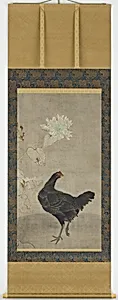
Black hen and a sunflower
1568-1615
Classification
Painting
Department
Smithsonian Collection
Museum
Smithsonian American Art Museum
Credit
Gift of Charles Lang Freer
Accession Number
F1896.39
Rights
Public Domain
Tags
About this artwork
The seal is a name of Kano Eitoku.
Art Historical Context
"Black Hen and a Sunflower" is a kakemono—a traditional Japanese hanging scroll painting—from the Momoyama period (15731615). Bearing the seal of Kano Eitoku (1543–1590), one of Japan's most celebrated painters of the Kano school, this work exemplifies the era's bold, decorative style. Though the artist is listed as unknown, the seal attributes it to Eitoku, renowned for his innovative use of vibrant colors, gold leaf, and dynamic compositions that adorned screens and scrolls for feudal lords. The painting features a striking black hen juxtaposed with a sunflower, rendered likely in ink and mineral colors on silk or paper—a medium ideal for kakemono's vertical format, designed to be unrolled for intimate viewing. Momoyama art emphasized opulence and natural motifs, reflecting the period's cultural flourishing amid samurai power struggles and tea ceremony aesthetics. This piece highlights the Kano school's mastery in capturing life's vitality through asymmetrical balance and textured brushwork. A gift from collector Charles Lang Freer to the Smithsonian Institution, it now resides in the Smithsonian American Art Museum's collection. Freer's passion for Asian art bridges Eastern traditions with American audiences, inviting us to ponder the timeless allure of nature's quiet drama in this rare gem.
About the Artist
Unknown
The artist designated as "Unknown" in our virtual museum's collection exemplifies a poignant chapter in art history: creators whose identities have faded into obscurity despite the enduring power of their work. With only one known artwork attributed to them in our holdings, this figure represents countless anonymous hands that shaped visual culture across centuries. Museums worldwide, including th...