
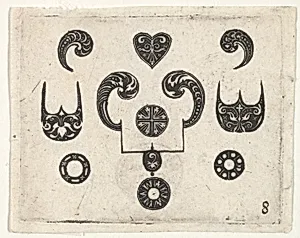
Blackwork Print with Various Motifs
Medium
blackwork
Dimensions
Plate: 1 5/8 x 2 in. (4.1 x 5.1 cm)
Classification
Prints|Ornament & Architecture
Department
Drawings and Prints
Museum
Metropolitan Museum of Art, New York, NY
Credit
The Elisha Whittelsey Collection, The Elisha Whittelsey Fund, 1956
Accession Number
56.500.112
Rights
Public Domain
Tags
Art Historical Context
In the early 17th century, during the Dutch Golden Age, printmakers like Claes Jansz. Visscher, a prolific engraver and publisher, and collaborator Georg Arnoldt produced intricate designs that bridged art and craft. This *Blackwork Print with Various Motifs*, dated around 1620, exemplifies their work in the genre of ornament and architecture prints. Measuring just 1 5/8 x 2 inches, its diminutive scale belies its practical purpose: a template for artisans creating lace, embroidery, or decorative objects. Rendered in blackwork—a technique using bold, dense lines of black ink to evoke texture and depth on paper—this print showcases an array of motifs likely inspired by Renaissance patterns. Visscher's style reflects Northern European Mannerism, with precise engraving that allowed for easy reproduction and dissemination across workshops. Housed in the Metropolitan Museum of Art's Drawings and Prints department, it highlights how such prints fueled the era's booming decorative arts trade. These modest yet masterful sheets were cultural powerhouses, standardizing motifs from scrolling foliage to geometric forms and influencing fashion and interiors throughout Europe. A testament to printmaking's democratic reach, this piece invites us to appreciate the unseen labor behind opulent textiles of the time.
About the Artist
Claes Jansz. Visscher|Georg Arnoldt · 1586–1652
Claes Jansz. Visscher, also known as Nicolas Joannis Visscher II or Joannis Piscator, was a prominent Dutch Golden Age draughtsman, engraver, mapmaker, and publisher born in Amsterdam in 1587 and died there on June 19, 1652. The son of the printmaker and publisher Jan Claesz. Visscher (c. 1550–1612), he learned the art of etching and printing from his father, helping to expand the family trade int...