
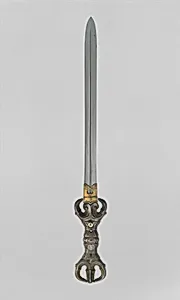
Blade and Mounting for a Double-Edged Dagger (Ken)
Unknown Artist
blade, late 12th–early 13th century; mounting, 14th century
Medium
Steel, wood, copper, gold
Dimensions
L. of blade 12 1/16 in. (30.6 cm); L. of cutting edge 8 3/16 in. (20.8 cm); L. of hilt 3 13/16 in. (9.7 cm)
Classification
Daggers
Culture
Japanese
Department
Arms and Armor
Museum
Metropolitan Museum of Art, New York, NY
Credit
H. O. Havemeyer Collection, Bequest of Mrs. H. O. Havemeyer, 1929
Accession Number
29.100.1369a–c
Rights
Public Domain
Art Historical Context
This exquisite blade and mounting for a double-edged dagger, known as a *ken*, exemplifies the masterful craftsmanship of medieval Japan. The steel blade, forged in the late 12th to early 13th century the transition from the He to Kamakura periods, measures 12 inches long with an 8-inch cutting edge showcasing the era's advanced metallurgy. Its later 14th-century mountingcrafted from wood, copper, and—adds opulent decoration, transforming the weapon into a ceremonial treasure rather than mere battlefield utility. Unlike the curved swords like the tachi or katana associated with samurai warriors, the straight, double-edged *ken* held deep cultural and ritual significance. Often wielded by Shinto priests in purification rites or exorcisms, it symbolized spiritual power and divine authority. The gold inlays and precise hilt construction highlight Japanese artisans' skill in blending functionality with aesthetic elegance, where even arms conveyed status and artistry. Housed in the Metropolitan Museum of Art's Arms and Armor Department from the H. O. Havemeyer Collection, this dagger offers a window into Japan's feudal world, where beauty and lethality intertwined. Visitors, marvel at how such a compact piece (hilt just under 4 inches) encapsulates centuries of tradition.