
Blades and Mountings for a Pair of Swords (Daishō)
blades, dated 1839; mountings, 19th century
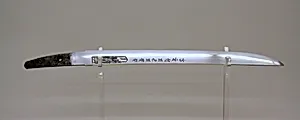
Medium
Steel, wood, lacquer, rayskin, silk, iron, copper-gold alloy (shakudō), copper, gold, silver, copper-silver alloy (shibuichi)
Dimensions
L. of sword (katana) 39 1/4 in. (99.8 cm); L. of sword (katana) blade 36 31/32 in. (93.9 cm); L. of sword (katana) blade cutting edge 28 5/8 in. (72.7 cm); D. of sword (katana) blade curvature 1 7/32 in. (3.1 cm); L. of short sword (wakizashi) 26 3/4 in. (67.9 cm); L. of short sword (wakizashi) blade 17 27/32 in. (45.3 cm); D. of short sword (wakizashi) blade curvature 9/64 in. (0.36 cm)
Classification
Swords
Culture
Japanese
Department
Arms and Armor
Museum
Metropolitan Museum of Art, New York, NY
Credit
Gift of Brayton Ives and W. T. Walters, 1891
Accession Number
91.2.56, .84
Rights
Public Domain
Art Historical Context
This exquisite *Daishō*—a matched pair of swords consisting of a katana (long sword) andizashi (short swordexemplifies the pinnacle of samurai craftsmanship from the late period. The blades, in 1839 by renowned swordsmith Naotane of the Taikei school feature precisely curved steel with cutting edges measuring 28⅝ inches for the katana and ⅞ inches for the wakiz. Mountings, crafted in the 19th by Honjō Yoshitane Yukinaka, include ornate fittings of shakudō (copper-gold alloy), shibuichi (copper-silver alloy), gold, and silver, wrapped around hilts of rayskin and silk, and housed in lacquered wooden scabbards. Japanese sword-making is a revered art form, blending metallurgical mastery with aesthetic elegance. The blades' subtle curvatures (1¼ inches for the katana, just ⁹⁄₆₄ inch for the wakizashi) optimize balance and slicing power, while the mountings showcase *togin* techniques—intricate chasing and inlaying evoking nature motifs or mythical scenes, symbols of status and virtue for samurai warriors. As a *daishō*, this pair was worn together by samurai, signifying their rank until the Meiji era's end to feudal traditions. Donated to the Metropolitan Museum of Art in 1891 by Brayton Ives and W.T. Walters, it invites visitors to appreciate the fusion of lethal function and poetic beauty in Japanese arms and armor.
About the Artist
Naotane Taikei|Honjō Yoshitane|Yukinaka (Japanese|Japanese|Japanese) · 1778 |1801 |1801 –1857 |1900 |1900
Japanese, Yamagata 1778–1857 Edo|Japanese, Edo period, 19th century|Japanese, Hagi, active 19th century