
Blanket or Rug
Late 19th century
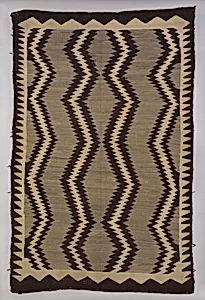
Medium
Wool, dovetailed tapestry weave; twined edges; (remnants of) corner knotted tassel
Dimensions
292.4 × 193.2 cm (115 1/8 × 76 1/8 in.)
Classification
textile
Department
Textiles
Museum
Art Institute of Chicago
Accession Number
153683
Rights
Public Domain
Art Historical Context
This stunning Navajo textile, known as a *Blanket or Rug*, the masterful weaving traditions of the DinéNavajo) people from the late 19th. Crafted from wool using a dovetailed tapestry weave—a technique where wefts interlock precisely at color changes for seamless patterns—this large piece measures an impressive 292.4 × 193.2 cm (115 1/8 × 76 1/8 in.). Its twined edges provide sturdy finishing, while remnants of corner knotted tassels at its original ornamental flair, typical of high-quality Navajo blankets prized for both utility and trade. Navajo weaving, primarily practiced by women on upright looms, flourished in the American Southwest during this era, blending indigenous ingenuity with influences from Spanish-introduced sheep and commercial markets. The dovetailed method allowed for bold geometric designs (though faded here), symbolizing harmony, protection, and storytelling in Diné culture. These blankets were essential for warmth, ceremonies, and as valuable commodities exchanged with settlers and traders. Today, housed in the Art Institute of Chicago's Textiles Department, this artifact invites us to appreciate the enduring legacy of Navajo artistry— a testament to resilience and technical virtuosity amid historical upheaval.