
Blanket or Rug
c. 1900 (Transitional Period)
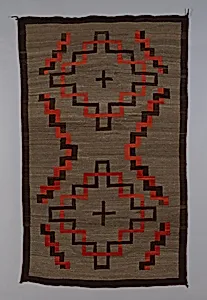
Medium
Wool, dovetailed tapestry weave; twined edges; corner knotted tassel; two selvages present
Dimensions
218.5 × 140.5 cm (86 × 55 1/4 in.); Warp repeat: H.: 104 cm (41 in.)
Classification
textile
Department
Textiles
Museum
Art Institute of Chicago
Accession Number
153686
Rights
Public Domain
About this artwork
This blanket or rug displays many of the characteristics of Navajo weavings made at the turn of the previous century. During this period, Navajo artists were working in an increasingly commercial environment, with many of their weavings destined for non-Indian buyers for display in their homes. Weavers also could sell their work through traders who would make suggestions on colors and designs in response to market trends. The design of this work is bold and straightforward, presenting two interl...
Art Historical Context
This stunning Navajo (Diné) blanket or rug, woven around 1900 during the Transitional Period, captures a pivotal moment in Diné textile artistry. The Transitional Period marked a shift in Navajo weaving traditions, as weavers adapted age-old techniques to new markets influenced by Anglo-American traders. Originally crafted for personal use as wearable blankets, these pieces began evolving into durable rugs, blending cultural continuity with emerging commercial demands. Expertly made from wool using a dovetailed tapestry weave—a hallmark of Navajo mastery that interlocks weft yarns without slits for seamless, vibrant patterns—the textile features twined edges for strength, corner knotted tassels for finish, and two selvages indicating handloom construction. The warp repeat of 41 inches suggests a rhythmic, modular design, showcasing the weaver's skill in creating balanced compositions on a grand scale (86 × 55¼ inches). Housed in the Art Institute of Chicago's Textiles Department, this piece exemplifies the enduring cultural significance of Diné weaving: a testament to women's ingenuity, storytelling through fiber, and resilience amid change. Visitors, imagine draping it as a blanket or admiring it as wall art—its tactile warmth invites reflection on Indigenous innovation.