
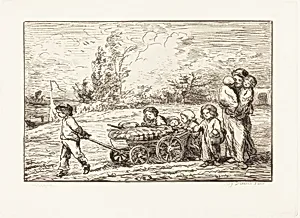
Boarding the Bottin (L'Emmenagement au Bottin)
Medium
etching
Classification
Portfolio
Department
CG-E
Museum
National Gallery of Art, Washington, D.C.
Credit
Gift of Joan Lees in memory of Edward Lees, M.D.
Accession Number
1981.58.5
Rights
Public Domain
Art Historical Context
Charles-François Daubigny, a leading figure in the Barbizon School of landscape painting, created *Boarding the Bottin (L'Emmenagement au Bottin)* in 1862 as an etching. This intimate print captures a moment of everyday life along the French waterways, likely referencing Daubigny's own houseboat, *Le Bottin*, which he launched that year as a floating studio on the Oise River near Paris. Belonging to the mid-19th-century Realist tradition, the work reflects the Barbizon artists' commitment to direct observation of nature, bridging Romanticism and the emerging Impressionist movement. Etching, Daubigny's favored printmaking technique, involved incising lines into a metal plate with acid, allowing for delicate tonal effects and atmospheric depth that mimicked his oil paintings' loose, luminous brushwork. This medium was significant for disseminating his rural scenes to a wider audience, making high art accessible beyond elite collectors. The artwork's presence in the National Gallery of Art's portfolio collection, gifted by Joan Lees in memory of Edward Lees, M.D., underscores its enduring appeal. Daubigny's innovation—painting en plein air from his boat—influenced contemporaries like Monet and Sisley, embodying the era's fascination with modernity and the countryside's fleeting beauty. Visitors will appreciate how this modest etching evokes the quiet poetry of river life in Second Empire France.
About the Artist
Charles-François Daubigny · 1817–1878
Charles-François Daubigny was born on February 15, 1817, in Paris into a family of artists, with his father, Edmé-François Daubigny, a classical landscape painter, and his uncle, Pierre Daubigny, a miniaturist, providing his initial artistic training. He further studied under Jean-Victor Bertin, Jacques Raymond Brascassat, and Paul Delaroche at the École des Beaux-Arts, though he quickly moved bey...