
Moving into the Boat
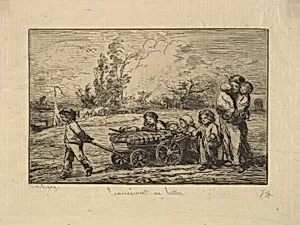
Medium
Etching; first state of three (Delteil)
Dimensions
Image: 4 1/2 × 6 11/16 in. (11.5 × 17 cm) Sheet: 7 1/16 × 10 1/16 in. (18 × 25.5 cm)
Classification
Prints
Department
Drawings and Prints
Museum
Metropolitan Museum of Art, New York, NY
Credit
Gift of Theodore De Witt, 1923
Accession Number
23.65.57
Rights
Public Domain
Tags
Art Historical Context
Charles-François Daubigny, leading figure in the Barbizon school landscape painting, captures a serene moment of rural life in his 1861 etching *Moving the Boat*. This first state of three, as cataloged by Delteil, measures a modest 4½ × 6⅝ inches and exemplifies Daubigny's skill in printmaking. A precursor to Impressionism, he often depicted the rivers and countryside around Paris, such as the Oise, infusing his works with natural light and atmospheric depth. The scene portrays women and children amid wagons, busily loading belongings onto a boat—evoking the simple rhythms of 19th-century French peasant life. Etching allowed Daubigny to translate his painterly brushstrokes into intricate lines, achieving subtle textures in water, foliage, and fabric that mimic the fluidity of his oils. Acquired as a gift to the Metropolitan Museum of Art in 1923, this print highlights Daubigny's versatility beyond canvas, bridging Romanticism and modernity. Visitors will appreciate its intimate scale and vivid storytelling, a window into an era when river transport shaped daily existence.
About the Artist
Charles-François Daubigny · 1817–1878
Charles-François Daubigny was born on February 15, 1817, in Paris into a family of artists, with his father, Edmé-François Daubigny, a classical landscape painter, and his uncle, Pierre Daubigny, a miniaturist, providing his initial artistic training. He further studied under Jean-Victor Bertin, Jacques Raymond Brascassat, and Paul Delaroche at the École des Beaux-Arts, though he quickly moved bey...