
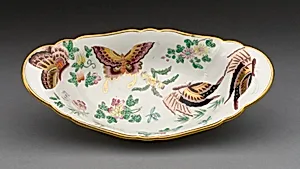
Boat-Shaped Dish
c. 1820
Medium
Porcelain with polychrome enamels and gilding
Dimensions
6.7 × 24.9 × 13 cm (2 5/8 × 9 13/16 × 5 1/8 in.)
Classification
dish (vessel)
Department
Applied Arts of Europe
Museum
Art Institute of Chicago
Accession Number
15010
Rights
Public Domain
Art Historical Context
Welcome to the Art Institute of Chicago's collection of European applied arts, where we encounter the elegant *Boat-Shaped Dish* by the renowned Wedgwood Manuf around 1820. This whimsical porcelain vessel, measuring 6.7 × 24.9 × 13 cm, mimics the form of a sailing boat, complete with delicate sails and rigging rendered in vibrant polychrome enamels and gilding. Wedgwood, founded by Josiah Wedgwood in the 18th century, had by the early 19th century high-quality bone china porcelain, blending functionality with fanciful design for the Regency-era dining table. The dish exemplifies the British ceramic industry's golden age, when manufacturers like Wedgwood rivaled continental porcelain makers such as Sèvres or Meissen. Polychrome enamels—fired-on colors applied over the glazed surface—allowed for intricate, jewel-like details, while gilding added opulent sparkle, evoking luxury silverware at a more accessible price. These techniques highlighted Wedgwood's innovative mass-production methods, making sophisticated tableware available to the growing middle class. As a sweetmeat or condiment dish, this piece reflects the playful neoclassical influences lingering into the Romantic period, turning everyday objects into miniature sculptures. A delightful survivor of 19th-century domestic life, it invites us to imagine lavish dinners afloat on a sea of elegance!
About the Artist
Wedgwood Manufactory
Wedgwood Manufactory, founded on 1 May 1759 by Josiah Wedgwood in Burslem, Staffordshire, England, revolutionized ceramics during the Industrial Revolution. Born into a family of potters, Josiah apprenticed under his elder brother Thomas at the Churchyard Works from age 14, mastering traditional techniques before partnering with Thomas Whieldon from 1754 to 1759, where he honed innovative glazes. ...