
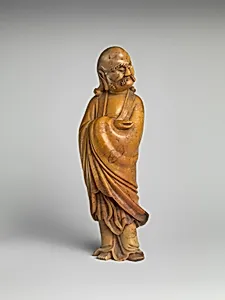
清 壽山石雕達摩像|Bodhidharma
Unknown Artist
19th century
Medium
Soapstone
Dimensions
H. 8 5/8 in. (21.9 cm)
Classification
Hardstone
Culture & Period
China · Qing dynasty (1644–1911)
Department
Asian Art
Museum
Metropolitan Museum of Art, New York, NY
Credit
Gift of Florence and Herbert Irving, 2015
Accession Number
2015.500.5.27
Rights
Public Domain
Tags
Art Historical Context
This exquisite soapstone carving of Bodhid, created by an unknown artist during China's Qing dynasty (16441911) in the 19th century, captures the legendary Indian monk who founded Chan (Zen) Buddhism. Standing just 8⅝ inches (21.9 cm) tall, the figure embodies the monk's iconic stern gaze and crossed-legged meditation pose, evoking his famous nine-year wall-facing meditation at Shaolin Temple. Shoushan stone, a-grained soapstone from Fujian province renowned for its translucency and subtle color variations, was a favored medium for such intricate carvings among Qing literati and collectors. Qing-era hardstone sculptors excelled in leveraging the stone's natural veining and softness to render lifelike textures—like the folds of Bodhidharma's robes and his bearded face—while polishing surfaces to a luminous sheen. This piece highlights the cultural reverence for Bodhidharma as a symbol of perseverance and enlightenment, bridging Indian origins with Chinese Buddhist traditions. Donated to the Metropolitan Museum of Art in 2015 by Florence and Herbert Irving, it invites visitors to ponder the meditative power of this diminutive yet monumental figure.