
Bologna
1826/1827
Medium
etching
Dimensions
sheet: 44.6 × 31.5 cm (17 9/16 × 12 3/8 in.)
Classification
Department
CG-E
Museum
National Gallery of Art, Washington, D.C.
Credit
Rosenwald Collection
Accession Number
1943.3.2075
Rights
Public Domain
Art Historical Context
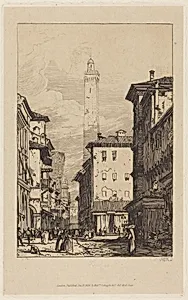
Richard Parkes Bonington’s etching *Bologna* captures the artist’s fascination with Italian architecture during his travels through northern Italy in the mid-1820s. Created between 1826 and 1827, the print reflects the Romantic period’s deep appreciation for historic European cities, where crumbling towers and sunlit piazzas became symbols of cultural memory and picturesque beauty. Bonington, though primarily celebrated for his luminous watercolors and oils, turned to etching to translate these atmospheric scenes into delicate lines and subtle tonal contrasts. As an etching, the work demonstrates the medium’s ability to convey both architectural precision and the soft play of light across stone surfaces. The sheet’s generous size—roughly 44 by 31 centimeters—allows the viewer to appreciate the fine detail Bonington achieved through this intaglio process. Now part of the National Gallery of Art’s Rosenwald Collection, *Bologna* offers modern audiences a glimpse of early nineteenth-century travel and the enduring appeal of Italy’s urban landscapes.
About the Artist
Richard Parkes Bonington · 1802–1828
Richard Parkes Bonington (1802–1828) was a British painter and watercolorist who, despite dying at the age of twenty-five, produced a body of work that had a profound and lasting influence on French and British painting. Born in Arnold, near Nottingham, he moved with his family to Calais and then Paris in 1817, where he studied at the École des Beaux-Arts under Antoine-Jean Gros and copied Old Mas...