
Bonbonnière
ca. 1756
Medium
Soft-paste porcelain
Dimensions
Overall: 1 7/8 × 2 1/4 in. (4.8 × 5.7 cm)
Classification
Ceramics-Porcelain
Culture
British, Chelsea
Department
European Sculpture and Decorative Arts
Museum
Metropolitan Museum of Art, New York, NY
Credit
Gift of Irwin Untermyer, 1971
Accession Number
1971.75.5a, b
Rights
Public Domain
Tags
Art Historical Context
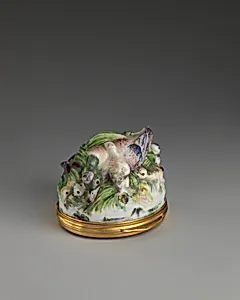
This exquisite *Bonbonnière*, crafted by the Chelsea Porcelain Manactory around 1756, is a charming example of 18th-century British luxury Measuring just under 2 inches across, this small, lidded box—likely designed to hold candies or snuff—was a fashionable accessory for the elite, blending functionality with opulent decoration. The Chelsea factory, one of England's pioneering porcelain producers, flourished in London during the mid-1700s, rivaling imported Chinese wares with its innovative designs, often featuring delicate motifs like birds, as suggested by this piece. Made from soft-paste porcelain, the bonbonnière showcases a key British achievement in ceramics. Unlike true hard-paste porcelain from Asia, soft-paste was a European formula using clay, ground glass, and other materials, fired at lower temperatures to create a creamy, translucent body ideal for intricate painting and gilding. Chelsea's mastery of this medium during its "Red Anchor" or early "Gold Anchor" period (circa 1752–1760) produced objects prized for their whimsy and technical finesse, reflecting the Rococo taste for playful, nature-inspired ornamentation. Housed in the Metropolitan Museum of Art's European Sculpture and Decorative Arts collection, this gift from Irwin Untermyer highlights Chelsea porcelain's cultural role in elevating British manufacturing. It evokes the elegance of Georgian high society, where such diminutive treasures were both status symbols and conversation starters.
About the Artist
Chelsea Porcelain Manufactory · 1744–1784
**Chelsea Porcelain Manufactory** The Chelsea Porcelain Manufactory, Britain's pioneering porcelain enterprise, was founded around 1743 in Chelsea, London, by two Huguenot silversmiths: Nicholas Sprimont from Liège and Charles Gouyn. Sprimont, trained in Paris as a goldsmith before immigrating to England, brought his expertise in luxury metalwork to the venture, while Gouyn handled early sales th...