
Bone Fragment
Unknown Artist
5th–8th century
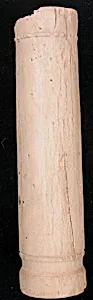
Medium
Bone; carved
Dimensions
H. 4 3/16 in. (10.6 cm) Diam. 1 in. (2.5 cm)
Classification
Ivories and Bone
Department
Islamic Art
Museum
Metropolitan Museum of Art, New York, NY
Credit
Gift of H. Dunscombe Colt, 1937
Accession Number
37.75.6
Rights
Public Domain
Art Historical Context
This delicate bone fragment, carved from animal bone in the 5th–8th centuries, offers a glimpse into the artistry of early Islamic craftsmanship. Measuring just 4 3/16 inches high and 1 inch in diameter, its petite scale suggests it was part of a small functional object, such as a handle, pin, or inlay for furniture or personal items. Donated to the Metropolitan Museum of Art in 1937 by H. Dunscombe Colt, it resides in the Islamic Art department, highlighting the museum's rich collection of ivories and bone works. Carved bone was a favored medium in the early Islamic world—spanning regions from the Near East to North Africa—due to its accessibility and workability. Artisans skillfully incised surfaces with fine tools to create intricate patterns, often echoing motifs from late antique traditions that blended with emerging Islamic aesthetics. Though the exact decoration on this fragment is subtle, its survival speaks to the durability of bone and the sophistication of techniques passed down through generations. For visitors, this unassuming piece underscores the everyday artistry of a transformative era, bridging pre-Islamic and Islamic cultures. It reminds us that grand history often hides in humble fragments, preserving whispers of ancient hands at work.