
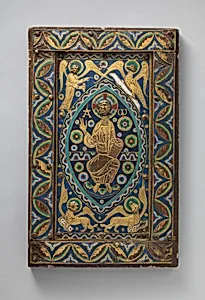
Book-Cover Plaque with Christ in Majesty
Unknown Artist
ca. 1210–20
Medium
Copper: engraved, chased, scraped, stippled, and gilt; champlevé enamel: dark and light blue, turquoise, green, yellow, red, and white
Dimensions
Overall (with wooden support): 10 5/8 x 6 5/8 x 13/16 in. (27 x 16.9 x 2 cm) enamels without wooden support: 10 1/4 x 6 5/16 in. (26.1 x 16 cm) center plaque: 8 1/4 x 4 1/4 in. (21 x 10.8 cm) vertical border plaques: 8 1/4 x 1 in. (21 x 2.6 cm) horizontal border plaques: 6 1/4 x 1 in. (15.9 x 2.6 cm)
Classification
Enamels-Champlevé
Culture
French
Department
Medieval Art
Museum
Metropolitan Museum of Art, New York, NY
Credit
Gift of J. Pierpont Morgan, 1917
Accession Number
17.190.798
Rights
Public Domain
Tags
Art Historical Context
This exquisite *Book-Cover Plaque Christ in Majesty*, crafted in France around 1210–20, once adorned the cover of a sacred Christian text, such as a Gospel book or Bible. At its center, Christ is depicted enthroned in majestic glory—a powerful Romanesque motif symbolizing divine authority and the Last Judgment—flanked by angels and the four Evangelists (Matthew, Mark, Luke, and John), whose symbolic creatures often appear in such compositions. The plaque's intricate design reflects the devotional art of medieval monasteries and cathedrals, where such covers protected holy manuscripts while proclaiming faith through vivid imagery. Masterfully executed in champlevé enamel—a hallmark technique of 12th- and 13th-century Limoges workshops—the artist engraved, chased, stippled, and gilded a copper base, creating cells filled with vibrant enamels in blues, turquoise, greens, yellows, reds, and whites. This labor-intensive process involved scraping out metal troughs, applying powdered glass colors, and firing to fuse them, yielding a durable, jewel-like glow that mimicked illuminated manuscripts or stained glass. The modular structure—central plaque with surrounding borders—allowed for assembly on a wooden support, showcasing medieval metalworkers' precision. A gift to the Metropolitan Museum of Art from J. Pierpont Morgan in 1917, this rare survivor highlights the cultural splendor of Gothic-era France, blending Byzantine influences with emerging Gothic naturalism. Its luminous enamels continue to captivate, inviting visitors to ponder the spiritual world of 13th-century devotees.