
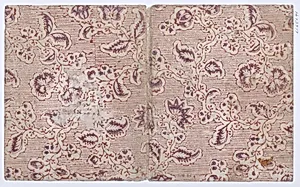
Book cover with overall paisley, dot, and stripe pattern
19th century
Medium
Relief print (wood or metal)
Dimensions
Sheet: 9 15/16 × 16 7/16 in. (25.2 × 41.8 cm)
Classification
Prints
Department
Drawings and Prints
Museum
Metropolitan Museum of Art, New York, NY
Credit
Gift of D. Lorraine Yerkes, 1961
Accession Number
61.651.41
Rights
Public Domain
Art Historical Context
This vibrant 19th-century book, featuring an all-over paisley, dot, and stripe pattern, exemplifies the decorative exuberance of Victorian-era design. Produced anonymously as a relief print—likely from wood or metal—the sheet measures 9 15/16 × 16 7/16 inches (25.2 × 41.8 cm), perfectly sized for binding onto books. Housed in the Metropolitan Museum Art's Drawings and Prints, it was generously gifted by D. Lorraine Yerkes 1961. Relief printing, a technique where ink adheres to raised surfaces carved from blocks, allowed for efficient mass production during the Industrial Revolution. This method democratized ornate designs, transforming everyday book covers from plain leather into eye-catching textiles-inspired confections. Paisley motifs, originally from Persian and Indian shawls, surged in popularity in Europe mid-century, symbolizing exoticism and affluence amid growing global trade. As a humble yet stylish artifact, this print highlights how 19th-century innovations in printing elevated printed ephemera to art. It invites us to appreciate the anonymous craftspeople whose patterns adorned countless libraries, blending utility with cultural flair.
About the Artist
Anonymous
In the vast tapestry of art history, "Anonymous" stands not as a singular individual but as a collective designation for countless unidentified creators whose works have endured across millennia. These artists, spanning prehistoric cave painters to medieval illuminators and folk craftsmen, produced the foundational layers of human visual culture. Prior to the Renaissance, when individual fame emer...