
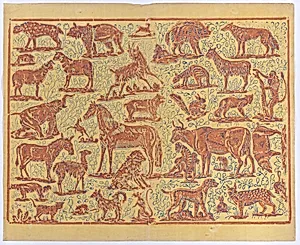
Book cover with overall pattern of animals
19th century
Medium
Relief print (wood or metal)
Dimensions
Sheet: 14 3/4 in. × 18 in. (37.4 × 45.7 cm)
Classification
Prints
Department
Drawings and Prints
Museum
Metropolitan Museum of Art, New York, NY
Credit
The Elisha Whittelsey Collection, The Elisha Whittelsey Fund, 1948
Accession Number
48.142.192
Rights
Public Domain
Tags
Art Historical Context
This charming 19th-century book cover, created anonymously, features an enchanting overall pattern of animals including cows, dogs, elephants horses, monkeys, and. Measuring 14¾ × 18 inches (37.4 × 45.7 cm), it exemplifies the decorative flair of printed bookbinding from the era, transforming functional objects into whimsical works of art. Housed in the Metropolitan Museum of Art's Drawings and Prints department as part of The Elisha Whitt Collection (acquired via The Elisha Whittelsey Fund in 1948), it invites viewers to imagine the delight of readers encountering this lively menagerie on their books. Crafted as a relief print—likely from wood or metal blocks—this technique involved carving away negative space to leave raised designs that could be inked and pressed onto paper or fabric. Popular in the 19th century for mass-producing affordable yet intricate patterns, relief printing allowed for bold, repeating motifs like these animals, blending folk art simplicity with playful exuberance. Such covers reflected the growing accessibility of printed materials during the industrial age, when books became everyday companions adorned with nature-inspired whimsy. Though the artist remains unknown, this piece highlights the anonymous craftsmanship that democratized beauty in Victorian-era publishing, offering a window into a world where even humble book covers burst with animal vitality and joy.
About the Artist
Anonymous
In the vast tapestry of art history, "Anonymous" stands not as a singular individual but as a collective designation for countless unidentified creators whose works have endured across millennia. These artists, spanning prehistoric cave painters to medieval illuminators and folk craftsmen, produced the foundational layers of human visual culture. Prior to the Renaissance, when individual fame emer...