
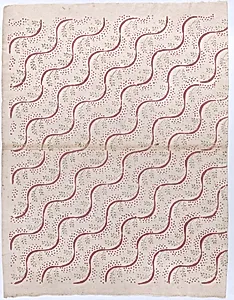
Book cover with overall red and green vine pattern
19th century
Medium
Relief print (wood or metal)
Dimensions
Sheet: 14 5/16 × 18 3/4 in. (36.4 × 47.6 cm)
Classification
Prints
Department
Drawings and Prints
Museum
Metropolitan Museum of Art, New York, NY
Credit
The Elisha Whittelsey Collection, The Elisha Whittelsey Fund, 1948
Accession Number
48.142.109
Rights
Public Domain
Art Historical Context
This 19th-century book cover design, featuring an intricate overall pattern of red and green vines exemplifies the anonymous artistry of decorative printing from the era. Produced as a relief print—likely from carved wood or metal blocks—the sheet measures 14 5/16 × 18 3/4 inches, making it suitable for covering larger volumes. Vine motifs, evoking nature's abundance and organic growth, were a staple in Victorian decorative arts, adorning everything from textiles to bindings as symbols of vitality and elegance. Relief printing, a technique where raised surfaces are inked and pressed onto paper, allowed for efficient, repeatable patterns ideal for the booming 19th-century publishing industry. This method, rooted in centuries-old woodblock traditions but refined with metal plates for durability, enabled mass production of ornamental covers that elevated everyday books into aesthetic objects. The bold contrast of red and green highlights the printer's skill in color registration, a technical feat in pre-industrial processes. Now housed in the Metropolitan Museum of Art's Drawings and Prints department, thanks to The Elisha Whittelsey Collection (acquired 1948), this piece offers a window into the overlooked craft of bookbinding design. It reminds us how anonymous makers shaped the visual culture of reading, blending utility with subtle beauty.
About the Artist
Anonymous
In the vast tapestry of art history, "Anonymous" stands not as a singular individual but as a collective designation for countless unidentified creators whose works have endured across millennia. These artists, spanning prehistoric cave painters to medieval illuminators and folk craftsmen, produced the foundational layers of human visual culture. Prior to the Renaissance, when individual fame emer...