
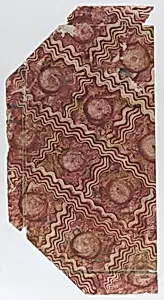
Book cover with overall red curved line pattern
19th century
Medium
Relief print (wood or metal)
Dimensions
Sheet: 8 7/16 × 16 1/2 in. (21.5 × 41.9 cm)
Classification
Prints
Department
Drawings and Prints
Museum
Metropolitan Museum of Art, New York, NY
Credit
Harris Brisbane Dick Fund, 1940
Accession Number
40.21.109
Rights
Public Domain
Art Historical Context
This striking 19th-century book, featuring an overall pattern of dynamic red curved lines, exemplifies artistry of anonymous printmakers who brought elegance to everyday objects. Created as a relief print—likely from wood or metal—the design was carved in relief so that raised surfaces inked up to transfer bold, repeating motifs onto paper or cloth. Measuring 8 7/16 × 16 1/2 inches, its elongated format perfectly suited covering a standard book, transforming utilitarian items into visually captivating pieces. In the 19th century, as printing technology advanced with the Industrial Revolution, relief printing became a go-to method for mass-producing decorative book covers. This technique allowed for vibrant, uniform patterns like the flowing curves here, evoking organic forms or textile weaves, which added whimsy and luxury to literature. Such designs reflected a growing appreciation for pattern in Victorian-era publishing, making books accessible yet aesthetically refined. Acquired through the Harris Brisbane Dick Fund in 1940 and housed in The Metropolitan Museum of Art's Drawings and Prints department, this anonymous work highlights the unsung craft of print designers. It invites us to appreciate how simple lines could convey rhythm and energy, bridging art and daily life in a transformative era.
About the Artist
Anonymous
In the vast tapestry of art history, "Anonymous" stands not as a singular individual but as a collective designation for countless unidentified creators whose works have endured across millennia. These artists, spanning prehistoric cave painters to medieval illuminators and folk craftsmen, produced the foundational layers of human visual culture. Prior to the Renaissance, when individual fame emer...