
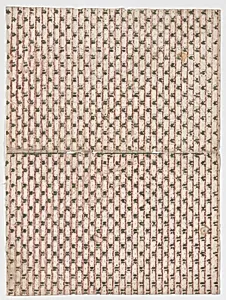
Book cover with overall stripe pattern with geometric designs
19th century
Medium
Relief print (wood or metal)
Dimensions
Sheet: 8 1/4 in. × 11 in. (20.9 × 27.9 cm)
Classification
Prints
Department
Drawings and Prints
Museum
Metropolitan Museum of Art, New York, NY
Credit
The Elisha Whittelsey Collection, The Elisha Whittelsey Fund, 1948
Accession Number
48.142.94
Rights
Public Domain
Art Historical Context
This exquisite 19th-century book cover, created anonymously through relief printing on wood or metal, showcases a striking overall stripe pattern interwoven with geometric designs. Measuring 8 1/4 × 11 inches, it exemplifies the era's innovative approach to bookbinding decoration, where printed covers both protected volumes and enticed readers with bold visual appeal. Housed in the Metropolitan Museum of Art's Drawings and Prints department as part of The Elisha Whittelsey Collection (acquired in 1948), it reflects the anonymous craftsmanship that fueled the booming print industry during industrialization. Relief printing, the technique used here, involved carving designs into a block, inking the raised surfaces, and pressing them onto paper—a efficient method ideal for mass-producing decorative elements like book covers, wallpapers, and textiles. In the 19th century, such patterns drew from everyday motifs like stripes and geometrics, evoking textiles, architecture, or folk art traditions, making books accessible and stylish for a growing literate public. Though the artist remains unknown, this piece highlights the unsung role of graphic design in everyday culture, bridging art and utility. Visitors will appreciate its timeless rhythm, a testament to how simple forms can captivate across centuries.
About the Artist
Anonymous
In the vast tapestry of art history, "Anonymous" stands not as a singular individual but as a collective designation for countless unidentified creators whose works have endured across millennia. These artists, spanning prehistoric cave painters to medieval illuminators and folk craftsmen, produced the foundational layers of human visual culture. Prior to the Renaissance, when individual fame emer...