
Bookbinding (Jild-i kitab)
Unknown Artist
19th century
Medium
Pasteboard; painted and lacquered
Dimensions
H. 8 7/16 in. (21.4 cm) W. 5 in. (12.7 cm)
Classification
Codices
Department
Islamic Art
Museum
Metropolitan Museum of Art, New York, NY
Credit
Gift of Sir Caspar Purdon Clarke, 1907
Accession Number
07.310.3
Rights
Public Domain
Tags
Art Historical Context
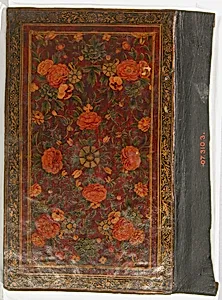
This exquisite 19th-century bookbinding, known as *Jild-i kitab* (Persian for "book cover hails from the Islamic world and exemplifies the artistry of manuscript protection in codices—bound volumes of sacred texts like the Qur'an or poetry. Housed in the Metropolitan Museum of Art's Art Department, it measures a compact 8 7/16 x 5 inches, designed to encase precious books while serving as a decorative object in its own right. Gifted in 1907 by Sir Caspar Purdon Clarke, the Met's first director, it reflects the era's fascination with Orientalist collecting. Crafted from pasteboard—a sturdy, layered material ideal for durability—the cover is adorned with painted and lacquered designs, likely featuring vibrant floral motifs as suggested by its tags. Lacquering provided a glossy, protective sheen, while painting allowed for intricate patterns that evoked paradise gardens, a hallmark of Islamic decorative arts avoiding human or animal figures. These techniques, rooted in Persian and Ottoman traditions, elevated bookbindings to miniature masterpieces, often rivaling illuminated pages in splendor. For visitors, this artifact reveals how 19th-century Islamic artisans transformed functional objects into symbols of piety and beauty, blending utility with opulent craftsmanship in everyday scholarly life.