
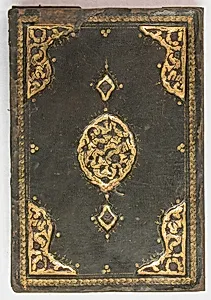
Bookbinding (Jild-i kitab)
Unknown Artist
17th–18th century
Medium
Leather; tooled and gilded
Dimensions
H. 8 1/2 in. (21.6 cm) W. 5 15/16 in. (15.1 cm) D. 15/16 in. (2.4 cm) Wt. 14 oz. (396.9 g)
Classification
Codices
Department
Islamic Art
Museum
Metropolitan Museum of Art, New York, NY
Credit
Anonymous Gift, 1974
Accession Number
1974.370.5
Rights
Public Domain
Art Historical Context
This exquisite bookbinding, known as *Jild-i kitab* (Persian for "book cover"), hails from the 17th–18th century in the world. Crafted from leather, it features intricate tooled designs—patterns pressed into the surface with heated tools—and gilding, where gold leaf adds shimmering elegance. Measuring just 8½ inches tall, it once encased a codex, a bound manuscript typical of Islamic scholarly and religious texts like the Quran or poetry collections. In Islamic art, bookbindings elevated the humble cover to a canvas of devotion and craftsmanship. Artisans drew from Persian and Ottoman traditions, blending floral motifs, geometric interlacing, and arabesques to symbolize paradise gardens. The tooled and gilded techniques not only protected fragile pages but transformed the object into a portable treasure, reflecting the era's reverence for knowledge amid thriving manuscript cultures in Safavid Iran or Mughal India. Today, housed in the Metropolitan Museum of Art's Islamic Art Department (anonymous gift, 1974), this artifact invites us to appreciate how everyday utility fused with artistry, making books cherished heirlooms across centuries.