
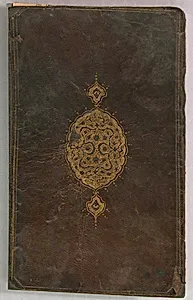
Bookbinding (Jild-i kitab)
Unknown Artist
17th–18th century
Medium
Leather; tooled and gilded
Dimensions
H. 8 3/16 in. (20.8 cm) W. 5 1/8 in. (13 cm)
Classification
Codices
Department
Islamic Art
Museum
Metropolitan Museum of Art, New York, NY
Credit
Anonymous Gift, 1974
Accession Number
1974.370.3
Rights
Public Domain
Art Historical Context
This exquisite bookbinding, known as *Jild-i kitab* ( cover), hails from the Islamic world of the 17th–18th century. Crafted by an unknown artist, it once protected a codex—a bound manuscript likely containing religious texts, poetry, or scholarly works central to Islamic intellectual life. Measuring just 8 3/16 x 5 1/8 inches, its compact size made it portable for personal devotion or study, reflecting the reverence for books in Persian, Ottoman, or Mughal traditions. The medium of leather, meticulously tooled and gilded, showcases masterful Islamic decorative arts. Tooling involved pressing intricate floral, geometric, or arabesque patterns into the dampened leather using heated metal stamps, creating raised designs that captured light beautifully. Gilding—applying gold leaf or paint—added a luminous, jewel-like quality, elevating the binding from mere utility to a luxurious object evoking paradise gardens promised in the Quran. In Islamic culture, such bindings were not just functional but symbolic of piety and craftsmanship, often rivaling the illuminated pages within. This anonymous 1974 gift to the Metropolitan Museum of Art invites us to appreciate the unsung artistry behind sacred knowledge, where every tooled line tells a story of devotion and skill.