
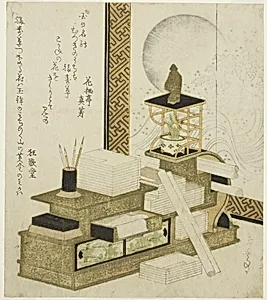
Bookcase with Writing Utensils, Books, and Potted Adonis
c. 1820s/30s
Medium
Color woodblock print; shikishiban, surimono
Dimensions
20 × 17.5 cm (7 7/8 × 6 7/8 in.)
Classification
woodblock print
Department
Arts of Asia
Museum
Art Institute of Chicago
Accession Number
23450
Rights
Public Domain
Art Historical Context
Welcome to the serene world of Yashima Gakutei'sBookcase with Writing Utils, Books, andotted Adonis*, a color woodblock print from the 1820s or 1830s, now housed in the Art Institute Chicago's Arts of Asia collection. This shikishiban surimono— a compact square format measuring just 20 × 17.5 cm—exemplifies the refined artistry of Japan's Edo period ukiyo-e tradition.akutei, a master printmaker known for his poetic and precise designs, crafted this intimate still life, blending scholarly objects like books and writing tools with a delicate potted Adonis flower, evoking themes of literati culture and seasonal beauty. Surimono prints like this one were privately commissioned luxuries, often produced for New Year's greetings or poetry circles, featuring lavish techniques such as vibrant colors, subtle embossing, and metallic accents for a tactile, jewel-like quality. Unlike mass-produced ukiyo-e, their exclusivity highlighted the connoisseur's taste, making this piece a window into elite Edo society. The careful composition—shelves brimming with inkstones, brushes, and volumes—celebrates the intellectual pursuits of the scholar, while the Adonis bloom nods to fleeting spring elegance, a motif rich in Japanese aesthetics. Gakutei's work bridges painting and printmaking, influencing later artists with its meticulous detail and harmony. A hidden gem for visitors, it invites quiet contemplation of everyday poetry in woodblock form. (198 words)
About the Artist
Yashima Gakutei · 1786–1868
Yashima Gakutei (c. 1786–1868), born in Osaka as the illegitimate son of a Tokugawa shogunate samurai named Hirata, adopted the name from his mother's subsequent marriage into the Yashima clan. Little is documented about his early years beyond these familial ties, but he pursued artistic training under the esteemed ukiyo-e masters Totoya Hokkei and Katsushika Hokusai, absorbing their precision in ...