
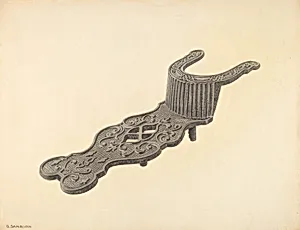
Bootjack
c. 1939
Medium
graphite on paperboard
Dimensions
overall: 27.9 x 36.2 cm (11 x 14 1/4 in.) Original IAD Object: 11 1/4" long; 3 1/2" high; 4 1/2" wide
Classification
Index of American Design
Department
CG-W
Museum
National Gallery of Art, Washington, D.C.
Credit
Index of American Design
Accession Number
1943.8.2038
Rights
Public Domain
Art Historical Context
Gordon Sanborn's *Bootjack* (c. 1939) is a meticulous graphite drawing on paperboard, capturing the humble yet ingenious form of a traditional American folk tool. Measuring 27.9 x 36.2 cm, this work renders a bootjack—originally 11 1/4 inches long, 3 1/2 inches high, and 4 1/2 inches wide—designed to grip the heel of a boot for easy removal. Sanborn's precise lines highlight the object's sturdy wooden construction, curved handle, and practical V-notch, transforming everyday utility into an artistic study of form and function. Created as part of the Index of American Design (IAD), a Works Progress Administration (WPA) project from 1935 to 1942, this piece reflects the era's effort to document and celebrate America's vernacular crafts amid the Great Depression. Artists like Sanborn produced thousands of detailed renderings of folk art, tools, and decorative objects, preserving cultural heritage through technical accuracy rather than embellishment. Housed in the National Gallery of Art's collection, it exemplifies the IAD's mission to honor the anonymous makers of America's material past. The bootjack, a staple of rural and frontier life, embodies Yankee ingenuity and self-reliance, evoking cowboys, farmers, and pioneers. Sanborn's graphite technique—layered shading for depth and texture—elevates this modest implement, inviting visitors to appreciate the artistry in the ordinary.
About the Artist
Gordon Sanborn · 1855–present
Gordon Sanborn is an artist whose work appears in museum collections in notable quantity, though the biographical details that would situate him within a specific tradition, school, or national context have not been well preserved in the available record. His name suggests an English-speaking background, and the volume of work attributed to him points to a career of real substance, even if the spe...