
Border
Unknown Artist
17th century
Medium
Embroidered net, buratto, punto à rammendo
Dimensions
L. 14 1/4 x W. 5 1/4 inches 36.2 x 13.3 cm
Classification
Textiles-Laces
Culture
German
Department
European Sculpture and Decorative Arts
Museum
Metropolitan Museum of Art, New York, NY
Credit
Rogers Fund, 1909
Accession Number
09.50.3185
Rights
Public Domain
Art Historical Context
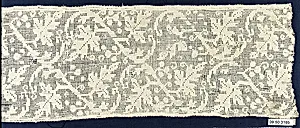
This delicate 17th-century lace border, crafted by an unknown German artist, exemplifies the exquisite textile arts of Baroque Europe. Measuring just 14¼ x 5¼ inches, it was likely designed for adorning garments like cuffs, collars, or ecclesiastical vestments, where such fine lace signified wealth and refinement. Acquired through the Rogers Fund in 1909, it now graces the Metropolitan Museum of Art's European Sculpture and Decorative Arts collection, highlighting Germany's contributions to lace-making traditions. The border's medium—embroidered net using *buratto* and *punto a rammendo* techniques—reveals sophisticated needlework mastery. *Buratto*, a form of lacis, involves darning intricate patterns over a geometric net ground, often on coarse linen, creating a durable yet ornamental fabric. *Punto a rammendo*, or darning stitch, fills voids with precise threads, mimicking woven motifs like florals or geometrics. These methods, rooted in Italian influences but adapted in German workshops, bridged embroidery and lace, making luxury accessible beyond bobbin varieties. In the 17th century, amid religious wars and opulent courts, German lace like this border reflected cultural exchanges and artisanal pride. Its preservation offers a tactile glimpse into daily elegance and the skilled hands behind Europe's decorative heritage.