
Border
1865/85
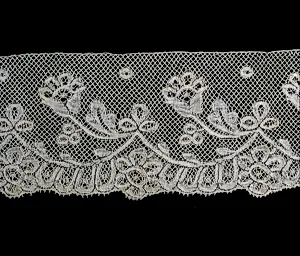
Medium
Cotton, bobbin straight lace of a type known as "Valenciennes" with a square Valenciennes mesh ground
Dimensions
7.7 × 112.7 cm (3 × 44 3/8 in.); Repeat: W.: 6.6 cm (2 5/8 in.)
Classification
textile
Department
Textiles
Museum
Art Institute of Chicago
Accession Number
27340
Rights
Public Domain
Art Historical Context
This delicate *Border* lace, crafted between 1865 and 1885, exemplifies the exquisite bobbin lace traditions of 19th-century Europe. Made from fine cotton threads in the style known as Valenciennes—a renowned type originating from the Flanders region of France and Belgium—this piece features a distinctive square mesh ground woven in straight strips. Measuring just 7.7 × 112.7 cm with a repeating pattern every 6.6 cm, its narrow, elongated form suggests it was designed as a trim for garments, linens, or household textiles, adding elegance to everyday luxury. Valenciennes lace, produced by skilled artisans using bobbins to twist and plait threads, was prized for its durability and intricate, openwork patterns that mimicked more expensive needle laces. During the Victorian era, when lace adorned everything from collars and cuffs to petticoats and curtains, handmade pieces like this represented a blend of cottage industry craftsmanship and burgeoning machine influences. Though the artist remains unknown, the precision of its mesh ground highlights the technical mastery required, making it a testament to the unsung labor of lace makers. Today, housed in the Art Institute of Chicago's Textiles department, this border invites us to appreciate the tactile artistry of a bygone craft, where tiny threads wove stories of fashion, trade, and tradition.
About the Artist
Unknown
The artist designated as "Unknown" in our virtual museum's collection exemplifies a poignant chapter in art history: creators whose identities have faded into obscurity despite the enduring power of their work. With only one known artwork attributed to them in our holdings, this figure represents countless anonymous hands that shaped visual culture across centuries. Museums worldwide, including th...