
Border
1675/1700
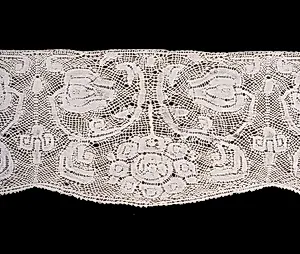
Medium
Linen, bobbin straight lace
Dimensions
9.5 × 503.4 cm (5 3/4 × 198 1/8 in.); Repeat: W.: 12.9 cm (5 1/8 in.)
Classification
textile
Department
Textiles
Museum
Art Institute of Chicago
Accession Number
31349
Rights
Public Domain
Art Historical Context
Welcome to the Textiles gallery, where we encounter *Border*, a stunning example of linen bobbin straight lace from around 1675–1700. This exquisite piece measures just 9.5 cm high but stretches an impressive 503.4 cm long, featuring a repeating pattern every 12.9 cm. Crafted by an unknown artisan, it showcases the meticulous bobbin lace technique, where linen threads are twisted and interwoven on bobbins to form delicate, openwork designs without needles. This method, popular in 17th-century Europe—particularly in Flanders and France—allowed for precise, geometric motifs that highlight lacemaker's extraordinary skill and patience. During the late Baroque era, lace like this was a hallmark of luxury and status, adorning the edges of garments, altar cloths, and household linens for the elite. Its straight, continuous format made it ideal for borders on sleeves, collars, or table runners, transforming everyday fabrics into opulent displays. The repeating floral or scroll-like patterns (inferred from typical bobbin lace of the period) reflect the era's ornate aesthetic, bridging the heavy drama of Baroque with emerging Rococo lightness. Though the maker remains anonymous, *Border* preserves a vanishing craft tradition, often practiced by women in convents or workshops. At the Art Institute of Chicago, it invites us to marvel at the tactile beauty of historical textiles—touch the threads with your eyes and imagine them fluttering on a noble's cuff.
About the Artist
Unknown
The artist designated as "Unknown" in our virtual museum's collection exemplifies a poignant chapter in art history: creators whose identities have faded into obscurity despite the enduring power of their work. With only one known artwork attributed to them in our holdings, this figure represents countless anonymous hands that shaped visual culture across centuries. Museums worldwide, including th...