
Border
1675/1725
Medium
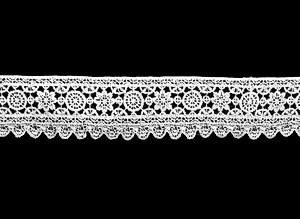
Linen, needle lace worked on a plain weave; cut and drawn thread work grid; edged with bobbin straight lace (probably a 19th century addition)
Dimensions
10 × 417.4 cm (4 × 164 1/2 in.); Needle width repeat: W.: 8.8 cm (3 1/2 in.); Bobbin width repeat: W.: 2.5 cm (1 in.)
Classification
textile
Department
Textiles
Museum
Art Institute of Chicago
Accession Number
72927
Rights
Public Domain
Art Historical Context
This exquisite *Border*, crafted between 1675 and 1725, is a masterful example of European textile artistry from the late Baroque era. Measuring a slender 10 × 417.4 cm, this linen piece was likely designed as a decorative edging for garments, table linens, or ecclesiastical vestments, showcasing the opulence of lacework during a time when such textiles signified wealth and refinement. Housed in the Art Institute of Chicago's Department, it highlights the anonymous skill of artisans who transformed humble linen into intricate finery. The border's core is needle lace worked on a plain-weave ground, featuring a cut-and-drawn thread work grid that creates an open, geometric foundation. Delicate motifs repeat every 8.8 cm in width, demonstrating the painstaking precision of needle lace techniques—where threads are looped and twisted by hand to form raised, sculptural patterns. A narrower bobbin straight lace edging, with a 2.5 cm repeat, was probably added in the 19th century, blending periods to preserve or enhance its appeal. Lace like this was a labor-intensive luxury, often taking months to produce, and reflects the cultural prestige of needlework in 17th- and 18th-century Europe. Its survival offers a tactile glimpse into historical craftsmanship, inviting visitors to appreciate the interplay of light and shadow in these fragile threads.
About the Artist
Unknown
The artist designated as "Unknown" in our virtual museum's collection exemplifies a poignant chapter in art history: creators whose identities have faded into obscurity despite the enduring power of their work. With only one known artwork attributed to them in our holdings, this figure represents countless anonymous hands that shaped visual culture across centuries. Museums worldwide, including th...