
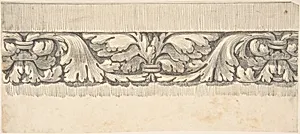
Border Design from a Classical Frieze, Decorated with Vines and Leaves
1776–79
Medium
Graphite
Dimensions
sheet: 5 5/8 x 12 5/8 in. (14.3 x 32.1 cm)
Classification
Drawings|Ornament & Architecture
Department
Drawings and Prints
Museum
Metropolitan Museum of Art, New York, NY
Credit
Harris Brisbane Dick Fund, 1934
Accession Number
34.78.2(77)
Rights
Public Domain
Tags
Art Historical Context
Step into the refined world of 18th-century neoclass with Thomas Hardwick's *Border Design from a Classicalieze, Decorated withines and Leaves* (1776–79). This delicate graphite drawing captures the intricate scrolling vines and lush foliage that adorned ancient friezes, evoking the grandeur of Greco-Roman architecture. Hardwick a prominent English architect and son of a fellow architect, meticulously rendered these motifs as part of his studies in classical ornamentation, bridging antiquity with Georgian-era design. Created during the height of the neoclassical revival—fueled by archaeological discoveries like Pompeii and Herculaneum—this sheet (5 5/8 x 12 5/8 in.) exemplifies the precision of architectural drafting. Graphite allowed Hardwick to achieve fine lines and subtle shading, essential for replicating stone-carved details on paper. As a record of ornamental vocabulary, it influenced British architecture, from grand estates to public buildings, emphasizing harmony, proportion, and natural motifs symbolizing growth and eternity. Housed in the Metropolitan Museum of Art's Drawings and Prints department, thanks to the Harris Brisbane Dick Fund of 1934, this work invites us to appreciate how architects like Hardwick revived classical elegance, inspiring patterns still seen in modern decorative arts. A testament to enduring beauty in vine-wrapped borders!