
Design for a table with a cat mask and goat legs
1600–1640
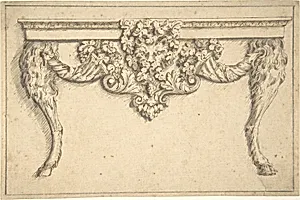
Medium
Pen and brown ink, brush and gray wash
Dimensions
sheet: 4 3/4 x 7 in. (12.1 x 17.8 cm)
Classification
Drawings|Ornament & Architecture
Department
Drawings and Prints
Museum
Metropolitan Museum of Art, New York, NY
Credit
The Elisha Whittelsey Collection, The Elisha Whittelsey Fund, 1959
Accession Number
59.608.95
Rights
Public Domain
Tags
Art Historical Context
In the early 17th century, designer John Payne crafted this whimsical "Design for a Table with a Cat Mask and Goat," dated around 1600–1640. Executed in pen and brown ink with brush and gray wash on a modest sheet measuring 4 3/4 x 7 inches, it exemplifies the intricate preparatory drawings favored by artists and craftsmen of the Renaissance and early Baroque eras. Housed in the Metropolitan Museum of Art's Drawings and Prints department as part of The Elisha Whittelsey Collection, work highlights the period's fascination with ornamental fantasy in furniture design. The design features a fantastical table leg blending a fierce cat mask with sturdy goat legs, accented by swirling leaves—evident from its tags of masks, cats, and foliage. Classified under Ornament & Architecture, it reflects the era's grotesque style, where mythical creatures inspired lavish household objects, merging utility with the exotic. Payne's precise pen lines delineate forms, while subtle gray washes add depth and shadow, bringing the creaturely elements to life on paper. This drawing offers a glimpse into the creative process behind opulent 17th-century interiors, where such hybrid motifs drew from classical antiquity and folklore. A charming survivor of its time, it invites us to imagine the bold table it might have become, blending playfulness with masterful draftsmanship.
About the Artist
John Payne · 1600–1640
John Payne is an artist whose biographical details remain difficult to establish with certainty, partly because the name is common and several artists of that name were active in different periods and countries. The works attributed to this John Payne suggest engagement with printmaking or illustration traditions, but without confirmed dates, nationality, or documented training, a precise account ...