
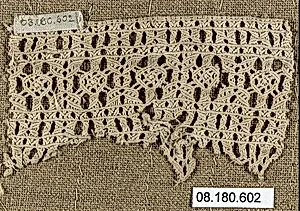
Border fragment
Unknown Artist
16th century
Medium
Macrame
Dimensions
L. 4 1/8 x W. 2 1/4 inches 10.5 x 5.7 cm
Classification
Textiles-Laces
Culture
Italian
Department
European Sculpture and Decorative Arts
Museum
Metropolitan Museum of Art, New York, NY
Credit
The Nuttall Collection, Gift of Mrs. Magdalena Nuttall, 1908
Accession Number
08.180.602
Rights
Public Domain
Art Historical Context
This exquisite *Border fragment*, crafted in 16th-century Italy, offers a glimpse into the Renaissance of intricate textile decoration. Measuring just 4 1/8 x 2 1/4 inches (10.5 x 5.7 cm), this piece exemplifies macramé—a knotted cord technique that flourished in Europe during this era. Likely intended as an edging for garments, linens, or ecclesiastical vestments, its fine linen threads are meticulously twisted and looped into geometric patterns, showcasing the patience and skill of anonymous Italian artisans. Macramé, derived from Arabic seafaring traditions and popularized in Italy by the 16th century, bridged the gap between simple knotting and elaborate bobbin lace. Known as *punto a groppo* in Italian workshops, it produced durable yet ornamental borders prized for their tactile elegance and symbolic motifs. This fragment's survival highlights the era's booming lace trade, centered in Venice and Milan, where such textiles adorned the elite and signified refined taste. Housed in the Metropolitan Museum of Art's Department of European Sculpture and Decorative Arts (Textiles-Laces), it entered the collection via The Nuttall Collection, gifted by Mrs. Magdalena Nuttall in 1908. A testament to everyday luxury from Renaissance Italy, it invites us to appreciate the artistry hidden in humble trims.