
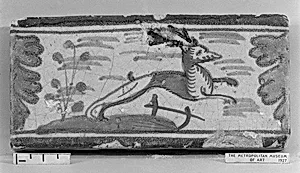
Border tile
Unknown Artist
early 17th century
Medium
Tin-glazed earthenware
Dimensions
Overall: 2 1/4 × 5 1/4 in. (5.7 × 13.3 cm)
Classification
Ceramics-Pottery
Culture
Flemish, Antwerp or Dutch
Department
European Sculpture and Decorative Arts
Museum
Metropolitan Museum of Art, New York, NY
Credit
Fletcher Fund, 1927
Accession Number
27.199.58
Rights
Public Domain
Tags
Art Historical Context
This delicate border tile, crafted in the early 17th century from tin-glazed earthenware,ails from either Flemish Antwerp or the Dutch Republic. Measuring just 2¼ × 5¼ inches, it likely served as an edging element in larger decorative panels or fireplace surrounds, adorning the interiors of prosperous homes. The tag "Deer" hints at a naturalistic motif—perhaps a graceful stag—captured in the vibrant blues and whites typical of this era's ceramics. Tin-glazing, a technique where a tin oxide layer creates an opaque, glossy white surface for intricate painted designs fired at low temperatures, was pivotal in Europe. Popularized in Antwerp workshops before flourishing in Dutch Delftware production, it allowed artisans to mimic expensive Chinese porcelain at an accessible price. This innovation democratized fine decoration during the Dutch Golden Age, blending local Flemish-Dutch craftsmanship with global trade influences. Acquired through the Fletcher Fund in 1927 and now in the Metropolitan Museum of Art's European Sculpture and Decorative Arts collection, this tile offers a glimpse into everyday opulence. It reflects the cultural vibrancy of a region at the crossroads of commerce and artistry, where humble earthenware elevated domestic spaces into works of subtle splendor.