
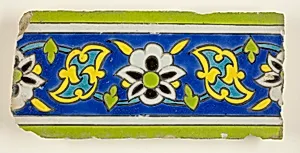
Border Tile With Vegetal Motif
Safavid dynasty (1501-1722), 17th/18th century
Medium
Stonepaste with cuerda seca polychrome glaze
Dimensions
11.3 × 24.3 × 2.3 cm (4 7/16 × 9 9/16 × 7/8 in.)
Classification
earthenware
Department
Arts of Asia
Museum
Art Institute of Chicago
Accession Number
10609
Rights
Public Domain
Art Historical Context
This exquisite *Border Tile With Vegetal Motif*ails from the Safavid (1501–1722), a golden age of Persian art in 17th- or 18th-century Iran. Crafted during a period when Shah Abbas I and his successors patronized lavish architectural projects, such tiles adorned the walls of mosques, palaces, madrasas, creating shimmering mosaics that evoked paradise gardens. The intricate vegetal patterns—flowing vines, leaves, and blossoms—reflect Islamic artistic traditions, where nature-inspired designs symbolized abundance and divine beauty while adhering to aniconic principles avoiding human or animal figures. Made of stonepaste (a fine earthenware body prized for its hardness and ability to mimic porcelain), the tile measures a modest 11.3 × 24.3 × 2.3 cm, perfect for edging larger panels. Its cuerda seca polychrome glaze technique is a highlight: artists applied a greasy, manganese-laced line (literally "dry cord" in Spanish, adopted via trade routes) to separate vibrant colors like turquoise, cobalt, and yellow, preventing them from bleeding during firing. This produced crisp, jewel-like outlines, showcasing Safavid potters' technical mastery and contributing to the era's renowned ceramic innovation. Today, housed in the Art Institute of Chicago's Arts of Asia department, this tile invites us to imagine vast, luminous interiors where light danced across such motifs, blending artistry with spirituality in everyday splendor.
About the Artist
Islamic
Islamic art, a profound visual tradition originating in the 7th century CE, flourished across vast territories from Spain to India under Muslim rule, encompassing architecture, ceramics, manuscripts, textiles, and metalwork produced by diverse artisans rather than a single named master. Drawing from pre-Islamic Sasanian, Byzantine, and late antique influences, its early development under the Umayy...