
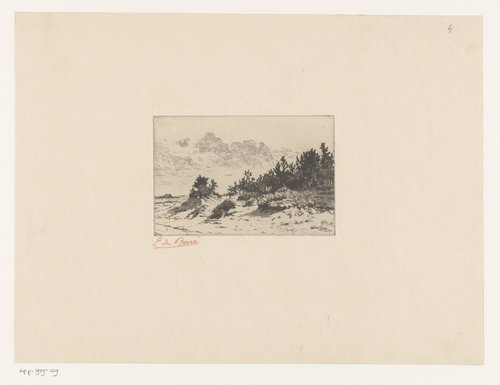
Bos aan de grens van het duinland
1865 - 1902
Medium
etching
Dimensions
98; 148
Rights
Public Domain
About this artwork
height 98 mm x width 148 mm
Art Historical Context
Emile de Baré’s etching “Bos aan de grens van het duinland” presents a compact view of a forest edging onto open dune terrain. Measuring only 98 by 148 millimeters, the print encourages intimate viewing, rewarding the eye with delicate lines that suggest shifting sands, clustered trees, and subtle light filtering through branches. Etching was a favored medium in the late nineteenth century for its ability to capture fine textures and tonal gradations through the controlled use of acid on metal plates. De Baré’s choice of this technique allowed him to translate the quiet transition between woodland and coastal landscape into a reproducible image, making such scenes available beyond the original drawing. Produced during the artist’s lifetime (1865–1902), the work belongs to a period when many European printmakers explored regional nature subjects. The Dutch title points to the dune-rich coasts of the Low Countries, where artists often found inspiration in the interplay of vegetation and shifting sands.
About the Artist
Emile de Baré · 1855–1902
**Emile de Baré (also styled Emile De Baré or Emile Marie Adolphe Joseph De Baré de Comogne) was a Belgian artist born in 1855 in Namur and who died in 1902 in Liège.** He is best known for his black-and-white etchings depicting rural landscapes, frequently featuring cottages, trees, and quiet countryside scenes. De Baré worked in both etching and oil painting. Auction records document canvases s...