
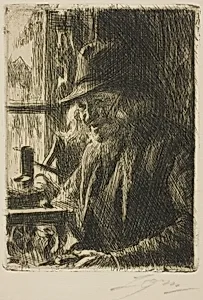
Bosl Anders, Clockmaker at Mora
1907
Medium
Etching on ivory laid paper
Dimensions
Image/plate: 15.9 × 11.7 cm (6 5/16 × 4 5/8 in.); Sheet: 36 × 24.2 cm (14 3/16 × 9 9/16 in.)
Classification
etching
Department
Prints and Drawings
Museum
Art Institute of Chicago
Accession Number
42135
Rights
Public Domain
Art Historical Context
Anders Zorn's *Bosl Anders, Clockmaker at* (1907) captures the quiet dignity of everyday Swedish life in the rural town of Mora, a region Zorn cherished for its folk traditions. As a leading figure in late 19th- and early 20th-century Swedish art, Zorn blended Realism with Impressionistic light effects, often portraying working-class subjects with empathy and immediacy. Here, the etching portrays Bosl Anders, a local clockmaker, embodying Zorn's fascination with authentic portraits of ordinary people, which contrasted with the era's focus on aristocracy or exotic themes. This intimate work is an etching on ivory laid paper, a technique where Zorn incised intricate lines into a copper plate with acid, allowing for rich tonal depth and velvety textures. Measuring just 15.9 × 11.7 cm, its small scale invites close viewing, revealing the master's skill in rendering fabric folds, aged skin, and subtle shadows—hallmarks of his 280+ etchings. Printed on a larger sheet (36 × 24.2 cm), it exemplifies early 20th-century printmaking's accessibility, bridging fine art and reproduction. Housed in the Art Institute of Chicago's Prints and Drawings Department, this piece highlights Zorn's international acclaim, bridging Scandinavian heritage with global audiences and celebrating the unsung craftsman in a mechanizing world.
About the Artist
Anders Zorn · 1860–1920
Anders Zorn (1860–1920), one of Sweden's most celebrated artists, was born on February 18 in Utmeland near Mora in Dalarna, and raised on his maternal grandparents' farm in the nearby hamlet of Yvraden. Displaying prodigious talent from a young age, he attended school in Mora Strand until age twelve, followed by secondary grammar school in Enköping, where he excelled in drawing people and horses. ...