
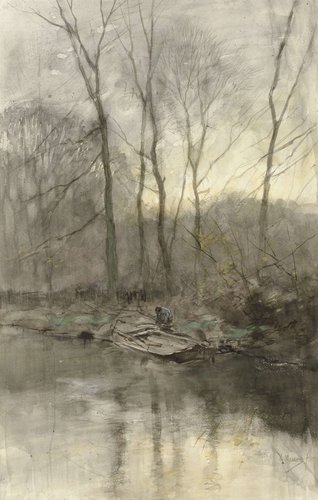
Bosrand aan het water
1848 - 1888
Medium
brush
Dimensions
382; 600
Rights
Public Domain
About this artwork
signature: ‘A Mauve f’
Art Historical Context
**Bosrand aan het water (*Forest Edge by the Water*), painted by Anton Mauve between 1848 and 1888, captures the serene beauty of the Dutch countryside. Mauve, a leading figure in the Hague School—a 19th-century movement of realist painters who celebrated the moody skies and subtle light of the Netherlands—signed this work with his distinctive "A Mauve f." Measuring 600 mm high by 382 mm wide, it's an intimate landscape executed with brushwork that evokes the soft, atmospheric quality for which he was renowned. Mauve's technique emphasized everyday rural scenes, often using loose, textured brushstrokes to convey the damp mists and golden hues of coastal woodlands. This painting likely depicts a wooded fringe meeting a quiet waterway, a motif reflecting the artist's deep connection to nature and his time in places like Laren and Drenthe, where he sketched en plein air. The Hague School's focus on unidealized realism marked a shift from Romanticism, influencing later Impressionists. Housed in the Rijksmuseum, Amsterdam's premier collection of Dutch masters, *Bosrand aan het water* exemplifies Mauve's legacy as a bridge between tradition and modernity. Visitors can appreciate how its modest scale invites close contemplation of fleeting natural light, a timeless reminder of the Netherlands' enduring landscape heritage.
About the Artist
Anton Mauve · 1838–1888
Anton Mauve (1838–1888), born Anthonij Rudolf Mauve in Zaandam, Netherlands, hailed from a family of North Holland clergymen. At age 16, he apprenticed under animal painter Pieter Frederik van Os in Haarlem, mastering depictions of livestock, before studying briefly with Wouterus Verschuur, whose equine subjects instilled a lifelong affinity for horses. He honed his plein air technique alongside P...