
Bottle
Unknown Artist
late 17th century
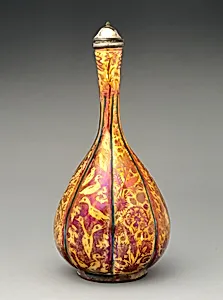
Medium
Stonepaste; luster-painted on yellow glaze ground with cobalt blue glaze
Dimensions
H. 15 in. (38.1 cm) Max Diam. 5 1/4 in. (13.3 cm)
Classification
Ceramics
Department
Islamic Art
Museum
Metropolitan Museum of Art, New York, NY
Credit
Edward C. Moore Collection, Bequest of Edward C. Moore, 1891
Accession Number
91.1.197
Rights
Public Domain
Tags
Art Historical Context
This elegant bottle from the late 17th exemplifies the masterful ceramics of the Islamic world, crafted from stonepaste—a composite material of quartz, clay, and frit that allowed artisans to create thin, translucent bodies mimicking Chinese porcelain. Standing 15 inches tall with a graceful swelling form (max diameter 5¼ inches), it features a yellow glaze ground adorned with luster-painting and cobalt blue glaze. The luster technique, involving metallic oxides fired in a low-oxygen kiln, produces a shimmering, iridescent glow that catches the light, evoking luxury and otherworldly beauty. Produced during a period when Islamic potters in regions like Iran or the Ottoman Empire refined these opulent methods, the bottle likely served as both a functional vessel and a display piece for elite households. Bird motifs, hinted at in its decoration, were popular in Islamic art, symbolizing freedom, paradise gardens, or poetic themes from Persian literature. This rarity entered the Metropolitan Museum of Art through the Edward C. Moore Collection in 1891, highlighting 19th-century Western fascination with Eastern artistry. Today, it stands as a testament to the ingenuity of anonymous Islamic craftsmen, whose technical prowess in glaze and luster elevated everyday objects into treasures of enduring splendor.