
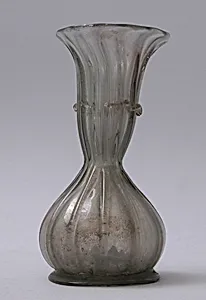
Bottle
Unknown Artist
18th–19th century
Medium
Glass; mold blown, applied decoration; tooled on the pontil
Dimensions
H. 5 3/16 in. (13.2 cm) Max. Diam. 2 5/8 in. (6.7 cm)
Classification
Glass
Department
Islamic Art
Museum
Metropolitan Museum of Art, New York, NY
Credit
Edward C. Moore Collection, Bequest of Edward C. Moore, 1891
Accession Number
91.1.1541
Rights
Public Domain
Art Historical Context
This delicate glass bottle, hailing from the Islamic world during the 18th19th century, exemplifies refined craftsmanship of the period. Standing just over 5 inches tall with a maximum diameter of ⅝ inches, it was created using mold-blown techniques, where molten glass was blown into a mold to produce textured surfaces, often mimicking intricate designs like facets or ribs. Additional applied decorations—such as trails or threads of glass—were meticulously added by hand, while the base was tooled on the pontil, a rod used in traditional glassblowing that left a characteristic mark, showcasing the artisan's skill in finishing without modern machinery. In the context of Islamic art, such bottles were everyday luxuries, likely used for perfumes, rosewater, or inks, reflecting the region's advanced glassmaking traditions rooted in earlier Abbasid and Ottoman innovations. These vessels highlight a cultural emphasis on beauty in utility, with techniques passed down through generations in centers like Syria, Egypt, or Persia. Though the artist remains unknown, the bottle's preservation speaks to its quality and the enduring appeal of Islamic decorative arts. Acquired through the Edward C. Moore Collection and bequeathed to The Metropolitan Museum of Art in 1891, this piece invites visitors to appreciate the subtlety of handcrafted glass—its iridescent potential under light and the tactile evidence of human ingenuity in every curve.