
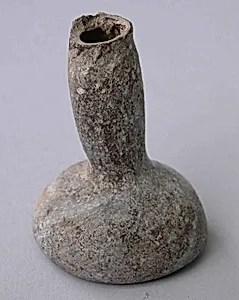
Bottle
Unknown Artist
7th–8th century
Medium
Glass; blown, tooled on the pontil
Dimensions
Ht. 1 5/8 in. (4.1 cm) W. 1 1/4 in. (3.2 cm) D. 1 1/8 in. (2.9 cm)
Classification
Glass
Department
Islamic Art
Museum
Metropolitan Museum of Art, New York, NY
Credit
Rogers Fund, 1932
Accession Number
32.150.150
Rights
Public Domain
Art Historical Context
This petite glass bottle, no taller than 1 5/8 inches (4.1 cm), hails from the 7th–8th century a golden age of early Islamic craftsmanship. Crafted in the Islamic Art tradition, its modest dimensions—1 1/4 inches wide (32 cm) and 1 1/8 inches deep (2.9 cm)—suggest it served as a delicate container, perhaps for precious oils, perfumes, or cosmetics, reflecting the era's appreciation for refined everyday luxuries. The bottle was skillfully made using blown glass techniques, a revolutionary method perfected in the Islamic world that allowed artisans to create thin-walled, lightweight forms with remarkable precision. It was tooled on the pontil—a long iron rod used to shape and detach the vessel—leaving a characteristic mark on its base. This labor-intensive process highlights the technical mastery of anonymous workshops, where glassblowing flourished alongside vibrant trade routes from Syria to Persia. Today, this treasure resides in the Metropolitan Museum of Art's Islamic Art Department, acquired through the Rogers Fund in 1932. It offers a window into the ingenuity of early Islamic artisans, whose subtle elegance continues to captivate.