
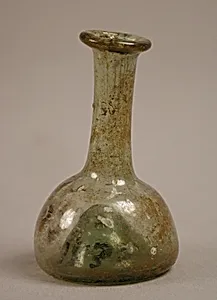
Bottle
Unknown Artist
14th–15th century
Medium
Green glass
Dimensions
Overall: 2 1/16 x 1 5/16 in. (5.3 x 3.3 cm) at lip: 5/8 in. (1.6 cm)
Classification
Glass-Vessels
Culture
European
Department
Medieval Art
Museum
Metropolitan Museum of Art, New York, NY
Credit
Munsey Fund, 1927
Accession Number
27.185.219
Rights
Public Domain
Art Historical Context
This delicate green glass bottle, dating to the 14th–15th century, exemplifies everyday artistry of medieval European glassmaking. Standing just over 2 inches tall with a narrow lip of about 5/8 inch, its petite scale suggests it was designed for personal use—perhaps to hold perfumes, oils, or medicinal tinctures. The soft green hue, a natural result of iron impurities in the silica, was highly prized in the period, evoking the lushness of nature and adding a touch of luxury to functional objects. Crafted during the late Middle Ages, when glass production flourished in regions like Venice and the Rhineland, this vessel likely employed free-blowing techniques. Molten glass was gathered on a blowpipe and shaped with careful puffs of air, allowing for the bottle's slender, elegant form without molds. Such vessels were not rare luxuries but vital household items, bridging the gap between utility and subtle beauty in pre-industrial Europe. Today, housed in the Metropolitan Museum of Art's Medieval Art department (acquired via the Munsey Fund in 1927), this unassuming bottle offers a window into daily life. It reminds us that medieval craftsmanship thrived in the ordinary, preserving the ingenuity of anonymous artisans whose work endured centuries.