
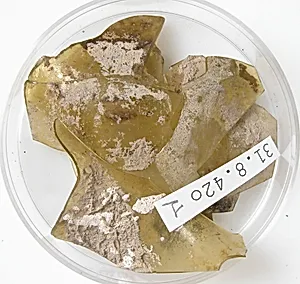
Glass Fragments
Unknown Artist
4th century
Medium
Glass (green)
Dimensions
Storage (petri dish diam.): 2 3/16 in. (5.5 cm)
Classification
Glass-Vessels
Culture
Coptic
Department
Medieval Art
Museum
Metropolitan Museum of Art, New York, NY
Credit
Rogers Fund, 1931
Accession Number
31.8.42.42a-i
Rights
Public Domain
Art Historical Context
These delicate green glass fragments, dating to the 4th century, offer a glimpse into the vibrant of Coptic Egypt, where early Christian communities thrived amid ancient traditions. Recovered as remnants of a vessel, they are housed in a modest petri dish measuring just 2 3/16 inches (5.5 cm) in diameter, highlighting the fragility of archaeological treasures. Acquired through the Rogers Fund in 1931, they now reside in the Metropolitan Museum of's Medieval Art Department, classified among glass vessels that once served daily or ritual purposes. Coptic culture, emerging in late antique Egypt, masterfully blended Pharaonic, Greco-Roman, and nascent Christian influences. Glassmaking was a sophisticated craft here, with green hues likely achieved through natural impurities like copper or iron in the silica-rich sands. These fragments exemplify the period's blown-glass techniques, which allowed for thin, luminous forms prized for their translucency and affordability compared to luxury imports. Though small, these shards whisper of everyday life—perhaps holding oils, perfumes, or wine in monastic or household settings. They remind us how humble objects illuminate history, bridging Egypt's pagan past and Christian future in the Met's esteemed collection.