
Bottle
1738–ca. 1777
Medium
Free-blown glass
Dimensions
H. 6 1/2 in. (16.5 cm)
Classification
Bottle
Culture
American
Department
The American Wing
Museum
Metropolitan Museum of Art, New York, NY
Credit
Purchase, Judith F. and William H. Hernstadt Gift, 1981
Accession Number
1981.83
Rights
Public Domain
Tags
Art Historical Context
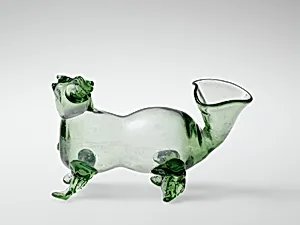
This delicate bottle, crafted at the Wistarburgh Glassworks 1738 and around 1777, exemplifies American ingenuity in glass production. Founded by German immigrant Caspar Wistar near Philadelphia, the Wistarburgh factory was the first successful glasshouse in the American colonies, operating from 1739 until Wistar's death in 1752 and beyond under his heirs. Standing just 6½ inches tall, this free-blown glass vessel highlights the factory's role in fostering self-sufficiency during a time when most fine glassware was imported from Europe. Free-blowing, the technique used here, involved gathering molten glass on a blowpipe and shaping it through skillful inflation and manipulation without molds—a labor-intensive process mastered by Wistarburgh's artisans, many of whom were imported German specialists. The bottle's decoration, featuring motifs of dogs, adds a touch of whimsy and reflects popular colonial tastes, possibly alluding to hunting culture or companionship in everyday life. Such utilitarian yet adorned pieces were prized for both function and subtle artistry. Housed in The Metropolitan Museum of Art's American Wing, this bottle (acquired through the Judith F. and William H. Hernstadt Gift in 1981) stands as a testament to America's emerging industrial identity, bridging craftsmanship and cultural expression in the pre-Revolutionary era.