
Bottle
2nd-6th century
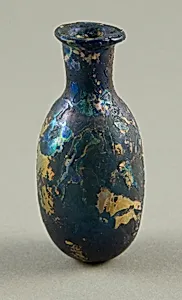
Medium
Glass, blown technique
Dimensions
6.7 × 2.9 cm (2 5/8 × 1 1/8 in.); Diam.: 2.9 cm (1 1/8 in.)
Classification
bottle
Department
Arts of Greece, Rome, and Byzantium
Museum
Art Institute of Chicago
Accession Number
65650
Rights
Public Domain
Art Historical Context
This delicate glass bottle, crafted by Ancient Roman artisans between the 2nd and 6th centuries CE, exemplifies the ingenuity of Roman glassmaking during the height of the Empire and into the early Byzantine era. Standing just 6.7 cm tall with a diameter of 29 cm, its petite form suggests it held precious oils, perfumes, or medicines—everyday luxuries made accessible through innovative techniques. The standout feature is the blown glass method, a revolutionary process likely pioneered in the Syro-Palestinian region around the 1st century BCE and perfected across the Roman world. Artisans gathered molten glass on a blowpipe, inflating it like a bubble to create thin, lightweight forms impossible with earlier casting methods. This allowed mass production of functional yet elegant vessels, flooding markets from Britain to Egypt and democratizing glassware. Housed in the Art Institute of Chicago's Department of Arts of Greece, Rome, and Byzantium, this bottle highlights Rome's enduring legacy in materials science and design. Its survival speaks to the material's durability and the cultural value placed on such unassuming beauties, bridging utility and artistry in antiquity.
About the Artist
Ancient Roman
The artists attributed to "Ancient Roman" in museum collections represent the anonymous craftsmen who produced the vast output of sculpture, frescoes, mosaics, and reliefs defining Roman visual culture from the Republic (c. 509–27 BCE) to the late Empire (c. 395 CE). Individual identities remain elusive, as Roman makers were typically viewed as skilled tradesmen—often enslaved Greeks or provincial...