
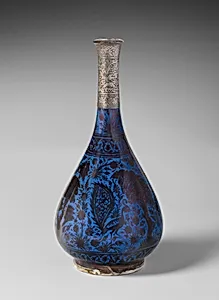
Bottle Depicting a Peacock in Foliage
Unknown Artist
17th century
Medium
Stonepaste; luster-painted on blue glaze under transparent glaze; silver mount
Dimensions
H. 13 1/2 in. (34.3 cm)
Classification
Ceramics
Department
Islamic Art
Museum
Metropolitan Museum of Art, New York, NY
Credit
Edward C. Moore Collection, Bequest of Edward C. Moore, 1891
Accession Number
91.1.188
Rights
Public Domain
Tags
Art Historical Context
This elegant 17th-century bottle from the Metropolitan Museum’s Islamic Art collection showcases the refined ceramic traditions of the period. Standing 13½ inches tall, the vessel is crafted from stonepaste—a durable, fine-grained material favored in the Islamic world—and features a striking peacock amid lush foliage. The bird’s form is rendered through luster-painting applied over a blue glaze and sealed beneath a transparent layer, producing a shimmering, metallic effect that catches the light beautifully. A later silver mount further enhances its refined appearance, suggesting the object was treasured across cultures and centuries. Lusterware like this required exceptional skill, as artisans applied metallic oxides that fused during a second firing in a reduced-oxygen kiln. The resulting iridescent surface evokes both luxury and the natural world, with the peacock symbolizing beauty, renewal, and paradise in many Islamic artistic traditions. Such bottles were often used for storing perfumes or rosewater, blending practical function with poetic decoration. Acquired by the Met through the 1891 bequest of Edward C. Moore, the piece invites visitors to appreciate how everyday objects became vehicles for artistic expression in the Islamic world. Its graceful silhouette and vibrant motif continue to speak across time.