
Bottle
Unknown Artist
second half 17th century
Medium
Stonepaste; luster-painted on opaque blue glaze under transparent colorless glaze
Dimensions
Ht. 9 1/8 in. (23.2 cm) Diam. 5 5/16 in. (13.5 cm)
Classification
Ceramics
Department
Islamic Art
Museum
Metropolitan Museum of Art, New York, NY
Credit
Edward C. Moore Collection, Bequest of Edward C. Moore, 1891
Accession Number
91.1.167
Rights
Public Domain
Art Historical Context
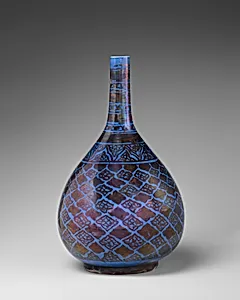
This elegant bottle, crafted by an unknown artist in the half of the 17 century, exemplifies the refined ceramics of the Islamic world. Standing at just over 9 inches tall with a diameter of about 5 inches, it was designed for practical use—perhaps holding perfumes, oils, or spices—while as a decorative object. Housed in the Metropolitan Museum of Art's Art Department, it entered the collection through the generous bequest of Edward C. in 1891, early Western appreciation for these treasures. The bottle's medium is a marvel of Islamic ceramic innovation: stonepaste (also called fritware), a quartz-based body that allowed potters to create thin, porcelain-like vessels resilient to the region's harsh clays. It's luster-painted on an opaque blue glaze, then coated with a transparent colorless glaze that protects and enhances the shimmering metallic effects. Lusterware, a technique perfected by Islamic artisans as early as the 9th century in Iraq and Persia, involved applying metallic oxides fired in a reducing atmosphere to produce iridescent gold and silver hues—evoking luxury and otherworldly beauty. Though its exact motifs remain subtle against the blue ground, this bottle reflects the Ottoman or Safavid era's blend of functionality and artistry, where everyday items became canvases for cultural expression. Visitors, pause to admire how light dances on its surface, a testament to centuries-old mastery.