
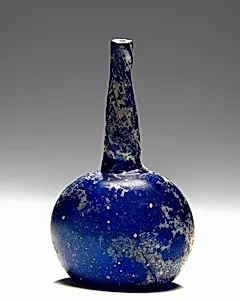
Bottle
Medium
Decorative Arts-Glass
Classification
Decorative Arts-Glass
Department
Smithsonian Collection
Museum
Smithsonian American Art Museum
Credit
Smithsonian American Art Museum, Gift of John Gellatly
Accession Number
1929.8.174.6
Rights
Public Domain
About this artwork
Most of the glass vessels in this case date from the first century BC to the fourth century AD. Early glass vessels were made in the Middle East and Egypt using the core-forming technique, in which molten glass was poured over a clay core and decorated with threads of colored glass. During the first century AD, Rome became the center of glassmaking, and the invention of blown glass led to new methods, including free-blown glass, which could be decorated by pinching, rolling, or dragging the surf...
Art Historical Context
This elegant glass bottle, part of the Smithsonian American Art's collection, hails from the ancient world, likely dating between the first century BC and the fourth century AD. Originating from early glassmaking hubs in the Middle East and Egypt before Rome's dominance, such vessels showcase humanity's ingenuity in crafting delicate, functional art. Gifted by John Gellatly, this piece exemplifies the decorative arts tradition preserved in the museum's trove of Roman-era glass. Early techniques like core-forming—where molten glass was draped over a clay core and adorned with colorful threads—gave way to revolutionary innovations in first-century Rome. The invention of glassblowing enabled free-blown forms, decorated by pinching or trailing, and mold-blown varieties etched with intricate patterns. Romans further dazzled with stratified glass, fusing multicolored canes, and millefiori, creating "thousand-flower" mosaics from sliced rods. Many such bottles ended up in wealthy tombs, where centuries of soil contact weathered their surfaces into a shimmering iridescence, adding a poetic patina. As a window into ancient luxury and craftsmanship, this bottle highlights glass's evolution from rarity to everyday elegance, bridging utility and beauty in Roman culture. Visitors, imagine sipping from its kin amid imperial feasts!
About the Artist
Unidentified ( ) · –