
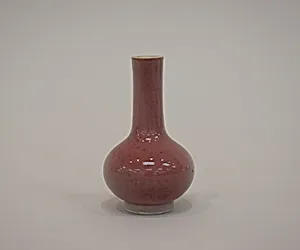
Bottle vase
Unknown Artist
18th century
Medium
Porcelain with copper red glaze (Jingdezhen ware)
Dimensions
H. 4 7/8 in. (12.4 cm); W. 2 7/8 in. (7.3 cm); Diam. of rim: 1 in. (2.5 cm); Diam. of foot: 1 11/16 in. (4.3 cm)
Classification
Ceramics
Culture & Period
China · Qing dynasty (1644–1911)
Department
Asian Art
Museum
Metropolitan Museum of Art, New York, NY
Credit
Bequest of Benjamin Altman, 1913
Accession Number
14.40.51
Rights
Public Domain
Art Historical Context
This exquisite bottle vase, crafted 18th-century China during the Qing (1644–1911), exemplifies the unparalleled porcelain artistry of Jingdezhen, the world's premier center for ceramic production. Standing just 4⅞ inches tall, with a slender form widening to a flared mouth (rim diameter 1 inch) and resting on a 1⅝-inch foot, its petite scale suggests it was designed as a decorative vessel—perhaps for holding a single flower stem or incense in a scholar's studio or elite household. The vase's standout feature is its copper red glaze, a technically demanding technique perfected at Jingdezhen kilns. Copper oxide in the glaze fires to a rich, oxblood hue known as sang de bœuf ("ox blood"), prized for its depth and subtle variations from the kiln's reducing atmosphere. Revived from Ming dynasty innovations, this glaze during the Qing era showcased imperial patronage and technical mastery, symbolizing luxury and refinement in Chinese export and domestic wares. Housed in the Metropolitan Museum of Art's Asian Art Department through the 1913 bequest of Benjamin Altman, this anonymous masterpiece invites visitors to appreciate the Qing's ceramic golden age, where form, glaze, and cultural elegance converged.