
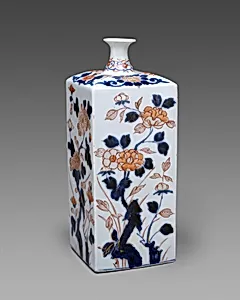
Bottle with flowers of the four seasons
Unknown Artist
ca. 1710
Medium
Hard-paste porcelain painted with colored enamels over transparent glaze (Hizen ware; Imari type)
Dimensions
Height: 8 5/8 in. (21.9 cm)
Classification
Ceramics-Porcelain-Export
Culture
Japanese, for European, probably Dutch, market
Department
European Sculpture and Decorative Arts
Museum
Metropolitan Museum of Art, New York, NY
Credit
The Hans Syz Collection, Gift of Stephan B. Syz and John D. Syz, 1995
Accession Number
1995.268.69
Rights
Public Domain
Tags
Art Historical Context
This elegant bottle, titled *Bottle with Flowers of the Four*, exemplifies the exquisite Hizen ware from Japan's Arita kilns, produced around 1710 specifically for the European export market, likely the Netherlands. Crafted from hard-paste porcelain—a, translucent material fired at high temperatures—the vase stands 8⅝ inches tall and features vibrant flowers painted in colored enamels over a transparent glaze. This Imari-type technique, named after the port of Imari from which wares were shipped, allowed for bold, overglaze colors like iron-red, cobalt blue, and gold that wouldn't fade during firing. The motif of flowers representing the four seasons—cherry blossoms for spring, peonies for summer, chrysanthemums for autumn, and pine or plum for winter—draws from Japanese aesthetic traditions, symbolizing nature's eternal cycle and harmony. Yet, tailored for Western tastes, it reflects the global trade boom of the early 18th century, when Dutch East India Company ships carried these coveted ceramics to fuel Europe's obsession with "China" (or Japanese) porcelain. As part of the Metropolitan Museum of Art's Hans Syz Collection, this piece highlights the fusion of Eastern craftsmanship and Western desire, bridging cultures through decorative arts. Its presence in the European Sculpture and Decorative Arts department underscores its role as a luxury import, adorning Dutch cabinets of curiosities and symbolizing exotic sophistication. A true gem of cross-cultural exchange!