
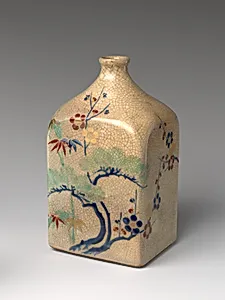
Sake Bottle (Tokkuri) with “Three Friends of Winter” (Pine, Bamboo, and Plum)
Unknown Artist
17th century
Medium
Glazed stoneware with polychrome enamels (Kyoto ware)
Dimensions
H.. 6 3/4 in. (17.1 cm); W. 3 3/4 in. (9.5 cm); D. 3 1/8 in. (7.9 cm)
Classification
Ceramics
Culture & Period
Japan · Edo period (1615–1868)
Department
Asian Art
Museum
Metropolitan Museum of Art, New York, NY
Credit
The Harry G. C. Packard Collection of Asian Art, Gift of Harry G. C. Packard, and Purchase, Fletcher, Rogers, Harris Brisbane Dick, and Louis V. Bell Funds, Joseph Pulitzer Bequest, and The Annenberg Fund Inc. Gift, 1975
Accession Number
1975.268.594
Rights
Public Domain
Tags
Art Historical Context
This elegant sake bottle, known as a *tokkuri*, hails from 17th-century Japan during the Edo period (1615–1868), a time of relative peace and flourishing craftsmanship. Produced in Kyoto ware kilns, it measures a compact 6 3/4 inches tall and served a practical purpose: warming and pouring sake at gatherings or meals. Kyoto ware, prized for its refined aesthetics, reflects the era's blend of everyday utility and artistic sophistication, appealing to the growing merchant class. The bottle's charm lies in its vibrant decoration of the “Three Friends of Winter”—pine, bamboo, and plum—traditional motifs symbolizing resilience and endurance. Pine evokes longevity, bamboo flexibility in adversity, and plum the promise of renewal as it blooms amid snow. Rendered in polychrome enamels over glazed stoneware, these overglaze colors pop against the creamy base, showcasing advanced ceramic techniques that allowed for intricate, painterly designs fired at lower temperatures. As part of the Metropolitan Museum of Art’s Asian Art collection, this piece highlights Japan's ceramic heritage, where functional objects doubled as symbols of harmony with nature. Imagine it gracing a festive table, warming both body and spirit!