
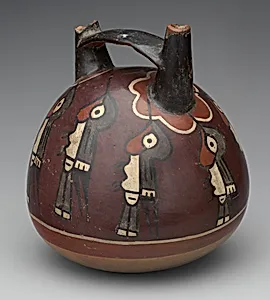
Bottle with hummingbirds
1–400 CE
Medium
Ceramic, slip
Dimensions
H. 6 × Diam. 5 in. (15.2 × 12.7 cm)
Classification
Ceramics-Containers
Culture
Nasca
Department
Arts of Africa, Oceania, and the Americas
Museum
Metropolitan Museum of Art, New York, NY
Credit
The Michael C. Rockefeller Memorial Collection, Gift of Emilio Sanchez, 1962
Accession Number
1978.412.91
Rights
Public Domain
Tags
Art Historical Context
This exquisite *Bottle with Hummingbirds*, crafted by Nasca artists between 1–400 CE, hails from the ancient Nasca culture of Peru's south coast. Made of ceramic with vibrant slip decoration, it measures a compact 6 inches high and 5 inches in diameter, exemplifying the Nasca mastery of pottery during their early phases. Housed in The Metropolitan Museum of Art's Arts of Africa, Oceania, and the Americas department, piece from The Michael C. Rockefeller Memorial Collection showcases the Nasca's innovative vessel forms, often designed for ritual use or storage. Nasca ceramics are renowned for their fine, polychrome slip-painting technique, where pigmented slips (liquid clay) were applied in intricate patterns before firing, creating vivid, naturalistic scenes. Here, the lively hummingbirds—frequent motifs in Nasca art—flutter across the bottle's surface, capturing the birds' dynamic energy with fluid lines and bold colors. These vessels highlight the culture's artistic prowess, blending functionality with symbolism in a pre-Columbian tradition that influenced later Andean pottery. Birds like hummingbirds held cultural significance for the Nasca, possibly representing fertility, the spirit world, or natural forces tied to their agrarian society and famous geoglyphs. This bottle invites us to marvel at how ancient artisans transformed everyday clay into windows on a vibrant, mystical past.